
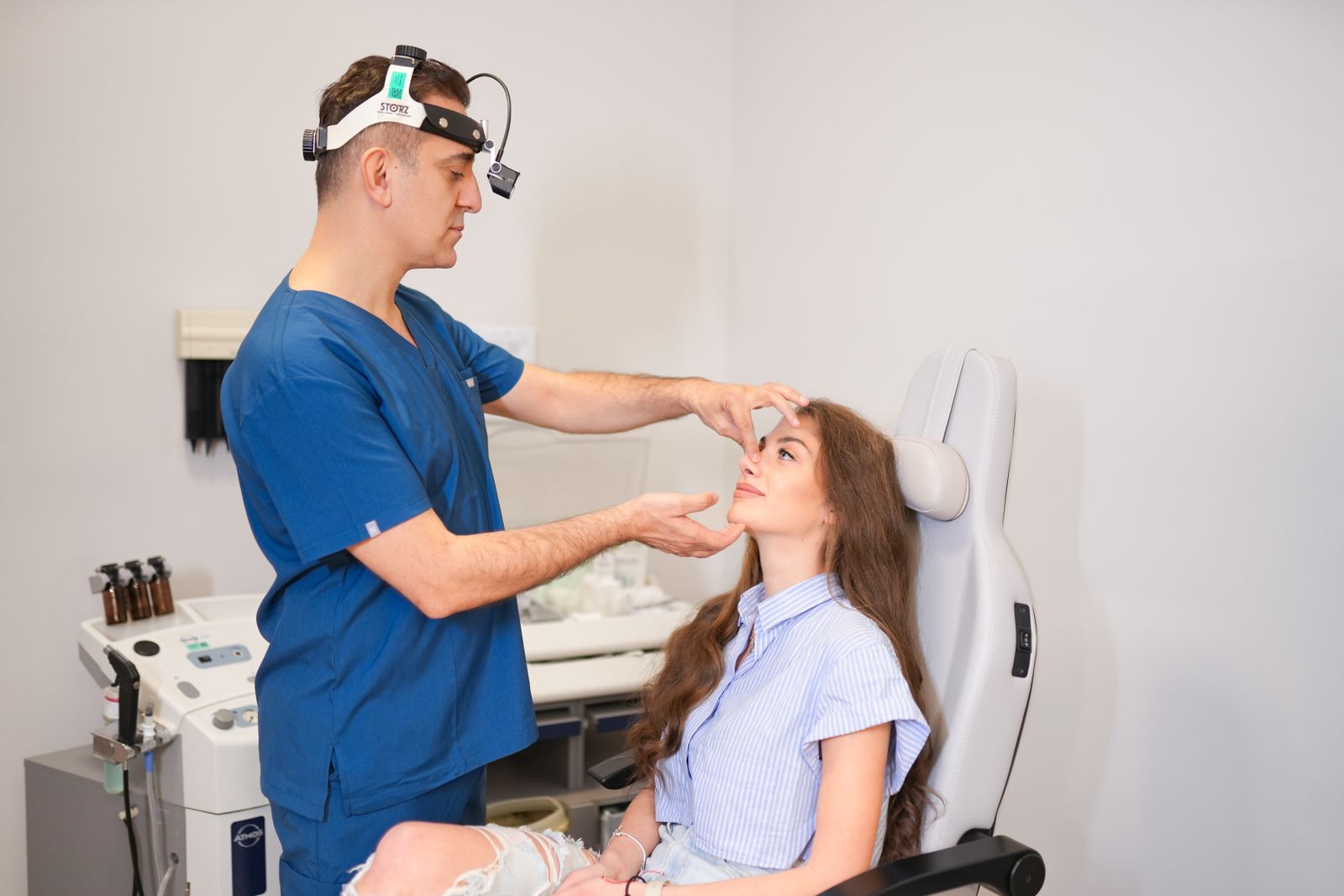
The nose occupies the exact centre of the face, which makes it uniquely unforgiving: nobody notices a good one, everybody notices a bad one — and its owner notices it in every photograph. Rhinoplasty is plastic surgery‘s most demanded and most technically demanding operation, precisely because success means creating a nose that looks like it was always there.
Rhinoplasty reshapes what bothers you — a dorsal hump, a drooping or bulbous tip, a crooked bridge, nostrils out of proportion. But many noses have an inside problem too: a deviated septum or collapsed valves that block breathing. Modern rhinoplasty treats both in one operation, straightening the airway while refining the exterior. If you snore, can’t breathe through one side, or rely on nasal sprays, say so at consultation — fixing the outside while ignoring the inside is half an operation.
A nose is not chosen from a catalogue; it’s derived from your facial proportions — chin projection, forehead angle, lip relationship, skin thickness, and ethnicity all shape what will look natural on you. We analyse your face and simulate realistic outcomes during planning, with preservation-minded technique that keeps structural support intact. The goal is harmony: people should notice your eyes, not your surgery.
Surgery takes two to three hours under general anaesthesia. The splint comes off at one week — and at that point you’re presentable, if swollen. Most bruising fades within two weeks; desk work resumes around then. But rhinoplasty rewards patience like no other procedure: the tip stays subtly swollen for months, and the true final result emerges at twelve months. We follow you through that entire year, because that’s how long the operation actually takes to finish.
Rhinoplasty carries the highest revision rates in plastic surgery industry-wide — almost always from over-resection or ignored airways. Our surgeons operate conservatively, preserving structure rather than carving it away, treat breathing as seriously as appearance, and simulate outcomes honestly at planning rather than overpromising. One operation, done right, followed for a full year: that’s the standard.
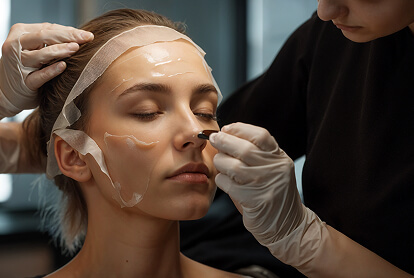

If you’ve spent years angling away from cameras — or years breathing through one nostril — book a rhinoplasty consultation at Dermax Medical Center in Dubai. Analysis, simulation, and straight answers before any decision.
Splint off at one week, socially presentable at two, exercise at four to six. But the honest timeline is longer: residual tip swelling resolves gradually, and the refined final result appears at around twelve months. It's the most patience-demanding recovery in aesthetic surgery — and worth preparing for mentally.
That's a technique question. Preservation-minded surgery that maintains structural support produces noses that function and age well; aggressive reduction produces the pinched, scooped look that reads as "done." Reviewing your surgeon's healed results — noses you couldn't tell were operated — is the best predictor.
Yes — deviated septums, enlarged turbinates, and collapsed valves are all correctable within the same operation. Combined functional-cosmetic rhinoplasty is routine here, and mentioning breathing problems at consultation is essential: the airway plan shapes the whole surgical approach.
Less than expected. Most patients report congestion and pressure rather than pain — the sensation of a bad cold more than an operation. Prescribed medication covers the first days comfortably. The harder part is the stuffiness while internal swelling settles over the early weeks.
A genuine option for the right case: filler can camouflage a modest hump, lift a slightly drooping tip, or smooth asymmetry in fifteen minutes with results lasting about a year. It cannot make a nose smaller or fix breathing. For some patients it's the perfect answer; for others it's a preview before surgery. We offer both, so the advice is unbiased.
Only after the first result has fully settled — a minimum of twelve months — and only when there's a defined problem: persistent asymmetry, breathing impairment, or over-resection. Revision is more complex than primary surgery, often requiring cartilage grafts, and demands a surgeon comfortable with reconstruction. Bring your surgical records if you have them.

Dermax Medical Center, your premier destination for medical, health, and aesthetic care in Dubai
DermaX Medical Center © 2026 All Rights Reserved. | Made with ♥ by BAYREZ
WhatsApp us